If you’ve ever walked through a modern automotive production facility, you’ve probably watched robotic arms weld car frames, conveyor belts seamlessly transfer parts between stations, and electronic systems adjust assembly line speeds in real time—all without a human stepping in to make those micro-adjustments. As a supplier of automotive industry production equipment, I’ve spent the last 12 years helping original equipment manufacturers (OEMs) and tier-one suppliers move past manual, error-prone lines to fully automated setups that cut downtime, reduce defect rates, and scale output faster than ever before. Automating an automotive production line isn’t just about swapping human workers for robots, though; it’s a structured, end-to-end process that accounts for your existing equipment, production goals, and long-term flexibility. Below, I’ll break down exactly how we approach this for our clients, using real-world examples from projects we’ve delivered to assembly lines for compact SUVs and electric vehicle (EV) battery packs. Automotive Industry Production Equipment
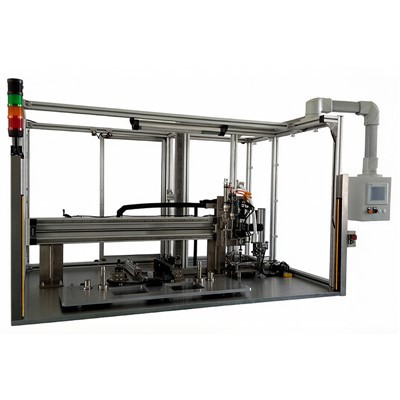
First, you have to start with a thorough line audit and goal alignment—something I’ve seen skippable projects derail within 18 months of launch. Too many manufacturers come to us saying, “We need more automation,” without defining what that actually means for their operation. Are they looking to increase output by 20% to meet new EV demand? Cut defect rates from 3% to under 0.5% to avoid warranty claims? Or reduce reliance on temporary workers during peak production months? For one mid-sized OEM we worked with a year ago, their primary pain point was a stamping line that experienced 12 hours of unplanned downtime monthly, all due to manual part loading that caused misalignments. We didn’t just propose a robot to replace a human there; we first mapped every step of that stamping line, noted the cycle times of each existing machine, the physical dimensions of incoming steel coils, and the amount of space available for new equipment. That audit also included talking to line operators, who shared that the biggest bottleneck wasn’t loading parts—it was waiting for maintenance technicians to adjust tooling between model runs. Those insights let us design an automation system that not only handled loading but also automatically calibrated tooling based on the specific model’s specifications, cutting downtime by 75% in the first quarter. Without that audit, we would have bought a standard robot that didn’t fit their line’s layout or address their real pain points.
Next, you need to select the right automation hardware, tailored to each line’s specific tasks. Automotive production lines have distinct stages—stamping, body welding, paint application, final assembly, and quality testing—each with unique requirements, so a one-size-f-all robot won’t work. For body-in-white welding, for example, you need high-precision robotic arms with multi-axis movement that can reach every spot on a car frame without colliding with adjacent parts. We use Fanuc R-2000iC series robots for these applications because their 2.6-meter reach and 10-kilogram payload let them handle heavy steel panels and weld up to 1,200 spots per hour, with consistent precision that manual welders can’t match. For paint lines, however, you don’t need a heavy-duty welding robot—you need a painting robot with electrostatic spray nozzles and color change capabilities that can switch between white, black, and metallic paints without cross-contamination. We often work with ABB IRB 5500 painting robots here, as their closed-loop spray control reduces paint waste by 15% compared to traditional spray guns, which is a big win for OEMs dealing with high paint costs. For assembly lines, which involve smaller, more delicate parts like door handles or electrical connectors, collaborative robots (cobots) are a better choice than industrial robots because they can work safely alongside human operators without fencing. Last year, we integrated Universal Robots UR10e cobots into a final assembly line for a compact car, where they now install dashboard components alongside line workers, reducing the time per dashboard from 12 minutes to 7. That shift eliminated a bottleneck that was causing the entire line to slow down during shifts with high worker turnover.
But hardware is only half the battle—software integration is what makes the line run smoothly, and this is where many inexperienced suppliers cut corners. An automated production line’s software needs to tie every piece of hardware, conveyor, and quality sensor into a single, easy-to-monitor system. For most of our clients, we use Siemens Totally Integrated Automation (TIA) Portal, a platform that lets you program all robots, conveyors, and inspection tools from one interface. This means that if a welding robot detects a misaligned panel, it sends an alert to the line supervisor’s tablet in real time, instead of waiting for a human to notice a defect after the car moves to the next station. We also integrate manufacturing execution system (MES) software into every automation project, which tracks every part’s origin, where it’s installed, and any quality checks it passes through. For an EV battery assembly line we delivered in 2022, the MES system lets us trace every battery cell back to its manufacturer, which is critical for regulatory compliance as EV safety standards get stricter. That system also reduced our client’s part recall time from 6 weeks to 10 days, because we can pull exact data on which cells went into which batteries. A common mistake we see is teams buying hardware from different vendors that don’t communicate well—for example, a robot from one company that can’t share data with a conveyor from another. We solve this by pre-testing all hardware and software in our in-house lab before it ships to the client’s facility, which cuts installation time by 30% and avoids costly on-site fixes.
Once the hardware and software are in place, you need to test and validate the line before full production, and provide ongoing training for the team that will run it. I’ve had clients who rushed into full automation deployment without testing, only to have the line shut down for a week when a small programming glitch caused a collision between two robots. Our process here is to run a 72-hour continuous test of the line using prototype parts, simulating every possible scenario—model changes, equipment errors, and minor power fluctuations—before we even begin installation on the client’s floor. For the battery assembly line, that test included running 500 simulated battery packs, intentionally introducing a few minor defects to make sure the quality inspection system caught them every time. We also provide two weeks of on-site training for line supervisors and operators, not just on how to start the line, but on how to troubleshoot common issues. For example, we teach operators to adjust a robot’s gripper pressure if it’s handling small plastic parts too roughly, instead of waiting for a technician to come from the supplier’s office. We also set up a remote monitoring system that lets our engineers access the line’s software from our headquarters, which means we can fix most issues in under two hours, instead of having to travel to the client’s facility. This support has been key for one of our long-term clients, a major truck manufacturer, who now runs three automated lines and has seen unplanned downtime drop by 80% over the past four years.
Finally, you need to design the line for future flexibility—because automotive production is changing fast, with new EV models and stricter emissions standards rolling out every two years. Too many manufacturers build automated lines that are only compatible with the current model, meaning they have to shut down and reconfigure the entire line every time they launch a new vehicle, which can cost millions and take months. We prioritize modular automation in every project, so that individual stations can be upgraded or replaced without rebuilding the entire line. For example, when we automated a small car assembly line in 2021, we designed the body welding stations to have quick-change tooling that can be re-calibrated for a new car model in less than four hours, instead of the two days it would have taken with a traditional fixed line. This flexibility was a big selling point for our client, who plans to launch two new EV models on that line over the next three years without major reconfiguration. We also build in scalability, so if a client wants to add a new quality inspection station or increase output by 15%, they can do that without replacing the entire automation system. Last year, one of our mid-sized OEM clients added a cobot station to their SUV assembly line to install rear-seat entertainment systems, and we were able to integrate it into their existing software in just three days, with no disruption to production.

At the end of the day, automating an automotive production line is a partnership, not a one-time equipment sale. As a supplier with deep experience in automotive production equipment, we don’t just sell robots and software—we work with you to map your goals, audit your existing line, design a system that fits your space and budget, and support you long after installation. If you’re looking to reduce downtime, cut defects, and scale your production to meet growing demand, we can walk you through every step of the process, from initial audit to ongoing support. Reach out to our team to schedule a consultation, where we can review your current line, discuss your goals, and outline a customized automation plan tailored to your operation.
Hydraulic Industry Production Equipment References
Automotive Manufacturing Association. (2023). 2023 State of Automotive Automation Report. AMA Press.
International Organization for Standardization. (2022). ISO 10218-1:2022, Robots for Industrial Environments — Safety Requirements. ISO.
Siemens AG. (2021). Totally Integrated Automation: TIA Portal User Guide. Siemens Digital Industries.
Shanghai Zenyan Automation Engineering Co., Ltd.
As one of the leading automotive industry production equipment manufacturers in China, we warmly welcome you to buy advanced automotive industry production equipment made in China here from our factory. All customized machines are with high quality and low price. Contact us for quotation.
Address: 3rd Floor, Building A, No.5629 Beisong Road, Chedun Town, Songjiang District, Shanghai, China
E-mail: zenyan_sh@163.com
WebSite: https://www.zenyanauto.com/
