If you’ve ever sourced aluminum die casting parts, you know the process can feel like navigating a black box. You send a drawing, get a quote, and sometimes it’s drastically different from a previous one, even for a part that looks almost identical. As someone who’s run an aluminum die casting parts supplier for 12 years, I’ve fielded this question a hundred times: “How do you actually calculate the cost of these parts?” It’s not just a number we pull out of thin air—there are 7 specific, interconnected factors that go into every quote, and understanding them can help you avoid budget gaps, speed up lead times, and build a better working relationship with your supplier. Let’s break them down, step by step, using real examples from jobs we’ve done. Aluminum Die Casting Partsr
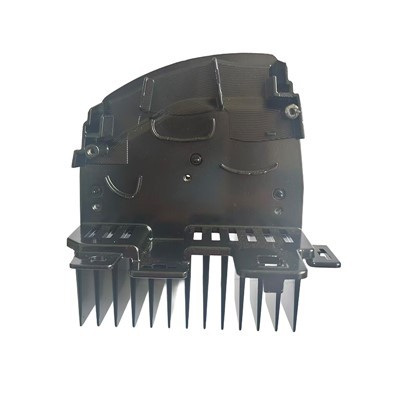
First, the foundation of every cost calculation is part design complexity. Not all aluminum die casting parts are the same, and even a small detail can shift the price by 20% or more. Last year, a customer came to us with two parts: both were bracket, same material (A380 aluminum), same weight (0.8 lbs), but one had 3 simple mounting holes and a flat edge, while the other had a 1-inch diameter threaded insert recess, a slotted tab that required undercut machining, and a draft angle of just 0.5 degrees (vs. the standard 2 degrees). The simple bracket cost $0.72 per unit, while the complex one was $0.89 per unit. Why? Undercuts and tight draft angles require more complex tooling—we can’t use a standard die that pulls straight; we need side cores, which add time to die manufacturing and increase the risk of defects. Threaded inserts also add a secondary operation: we have to load and set each insert into the die before casting, which adds labor and increases material waste if an insert is misaligned. Another design factor: part wall thickness. A part with uniform 2mm walls is much cheaper to cast than one that alternates between 1mm and 5mm. Thicker walls trap gas during casting, leading to porosity defects that require rework or scrapping; thinner walls are harder to fill evenly, requiring slower injection speeds and more process monitoring. Our team checks every dimension on the drawing against our die capability limits before we even open a quote file.
Next, material selection and yield drive a huge chunk of cost. Aluminum die casting uses several alloy types, and each has a different price per pound, plus different yields (the amount of raw metal that actually ends up in the finished part, not scrap). A380, the most common alloy for general-purpose parts, runs about $1.20 per pound as of 2024, but specialized alloys like A413 (for high-pressure casting) or ADC12 (used in automotive electronics) can cost 15-25% more. Yield is where it gets tricky. When you pour molten aluminum into a die, only 70-85% of the metal becomes the part; the rest is runners, gates, overflow wells, and sprues—parts of the die that hold the metal while it cools, then get trimmed off. Yield depends on part size and design: a small, dense part might have a 82% yield, meaning only 18% scrap, while a large, intricate part could have a 65% yield, with 35% scrap. For a part that weighs 0.5 lbs, a 82% yield means each finished part uses 0.61 lbs of aluminum, so material cost is $0.73. For the same part with a 65% yield, material cost jumps to $0.92. That’s a $0.19 difference per unit, and when you’re ordering 10,000 units, that’s $1,900 just in material scrap. We always calculate yield based on actual die tooling for the part, not a generic number, because guessing leads to incorrect quotes and unhappy customers down the line.
Then there’s die tooling cost, which is a one-time expense that gets amortized over your order quantity, but it’s often the biggest surprise for first-time buyers. Tooling for aluminum die casting is expensive: a simple die for a small bracket might cost $3,000, while a complex die for an automotive engine component with multiple undercuts and high precision can run $15,000 or more. The price depends on two things: the die material (H13 tool steel is standard, but some parts require higher-grade steel for longer life, which adds 10-15% to cost) and the number of cavities in the die. A 1-cavity die makes one part per cycle, a 4-cavity die makes four, so tooling cost per unit drops as cavity count goes up. For example, a $4,000 die: if you order 10,000 units, tooling cost per unit is $0.40; if you order 50,000 units, it’s $0.08. That’s why a lot of new customers don’t realize that their first quote includes tooling, but subsequent quotes don’t—once the die is made, you only pay for the parts. We always split tooling out separately in our quotes, so there’s no confusion: “One-time tooling: $4,200; Part cost (10,000 units): $0.55 per unit; Total: $9,700.” We also explain that tooling is custom, so any design changes after the die is cut can add another $500-$2,000 in rework, which is why we push to get final drawings approved before starting tooling.
Cycle time per part is another key factor that affects cost, because it’s tied directly to labor and machine usage. A die casting machine runs in cycles: pour metal, close die, inject, cool, open die, eject part, trim. The faster the cycle, the more parts you can make per hour, which lowers labor and machine overhead. A simple, small part can have a cycle time of 15-20 seconds, meaning a machine can make 180-240 parts per hour. A complex part with thick walls or multiple inserts can have a cycle time of 45-60 seconds, which cuts output to 60-80 parts per hour. Let’s do the math: a die casting machine runs about $75 per hour in overhead (electricity, maintenance, labor for the operator). For a simple part, that’s 180 parts per hour, so machine cost per unit is $0.42; for a complex part, it’s 60 parts per hour, so machine cost per unit is $1.25. That’s a massive difference, and it’s not just about the machine speed—we have to account for secondary operations too. If a part needs CNC machining, polishing, or coating, that adds more time per unit. A customer last year wanted a part that needed 3 post-cast CNC operations, which added 1.5 minutes per part, turning a $0.50 per unit part into $1.10 per unit. We always detail all secondary operations in the quote so customers aren’t blindsided by extra costs.
Order quantity and annual volume are the final big pieces of the puzzle. Suppliers often offer tiered pricing, because the more parts you order, the more you can optimize the process, reducing waste and labor. A quote for 1,000 parts will be higher than a quote for 10,000 parts, because small orders mean we have to set up the machine, run a small batch, and stop sooner, without getting the benefit of scale. But it’s not just one-time order quantity—we also look at annual volume. If a customer tells us they’ll need 50,000 parts a year for three years, we can invest in a more efficient 4-cavity die, which lowers tooling cost per unit and reduces cycle time, so the overall part cost is 10-15% lower than if they ordered 1,000 parts once. We also factor in minimum order quantities (MOQs) based on our die capability: most standard dies have a MOQ of 500-1,000 parts, but if we’re sharing a die between multiple small orders, we can lower the MOQ to 250 parts, though that might add a small surcharge for setup.
I’ve seen too many buyers assume all aluminum die casting quotes are the same, but that’s never the case. Last quarter, a customer got three quotes for the same custom bracket: one for $0.85 per unit, one for $1.10, one for $1.50. The $1.50 quote was from a supplier that used low-grade die steel, didn’t account for undercut machining, and underestimated material scrap, leading to constant rejections and delays. The $0.85 quote was from a supplier that cut corners on die quality, leading to a die that only lasts 50,000 cycles instead of 100,000, so over time, the cost per part goes up. The middle quote, $1.10, was from us—we explained that the price included a high-quality H13 die, accounted for the undercuts and insert machining, and projected 100,000 cycles, so the total long-term cost was lower. That’s why transparency is key: a good supplier won’t just give you a number, they’ll walk you through each factor that makes up the cost, so you can make informed decisions.
If you’re looking for a reliable aluminum die casting supplier that gives you clear, accurate cost breakdowns, we’re here to help. We work with startups and large manufacturers alike, offering custom solutions that balance cost, quality, and lead time. Whether you have a simple bracket design or a complex automotive component, we’ll review your drawings, explain all cost factors, and give you a fair, transparent quote. Contact us today to discuss your next project—let’s build something together.
Aluminum Die Casting Partsr References
ASM International. (2019). Aluminum Die Casting: Alloys, Processes, and Properties. ASM Handbook, Volume 15: Casting.
Dargusch, M. S., & Ghosh, A. (2021). Cost Optimization in High-Pressure Die Casting: A Review of Process and Design Variables. Journal of Manufacturing Processes, 67, 589-602.
Society of Die Casting Engineers. (2022). Die Tooling Cost Calculation Guide for Aluminum Die Casting. SME International.
Suzhou Ruide Die-Casting Mold Co., Ltd.
As one of the leading aluminum die casting partsr manufacturers and suppliers in China, we warmly welcome you to buy durable aluminum die casting partsr made in China here from our factory. All customized products are with high quality and competitive price. Contact us for pricelist.
Address: No.2, Wanchen Road, Huayang Village, Wangting Town, Xiangcheng District, Suzhou City, Jiangsu Province
E-mail: mia@cnrdmj.com.cn
WebSite: https://www.cnrdmold.com/
